
The Best Value Protein in Singapore: What to Actually Put in Your Trolley
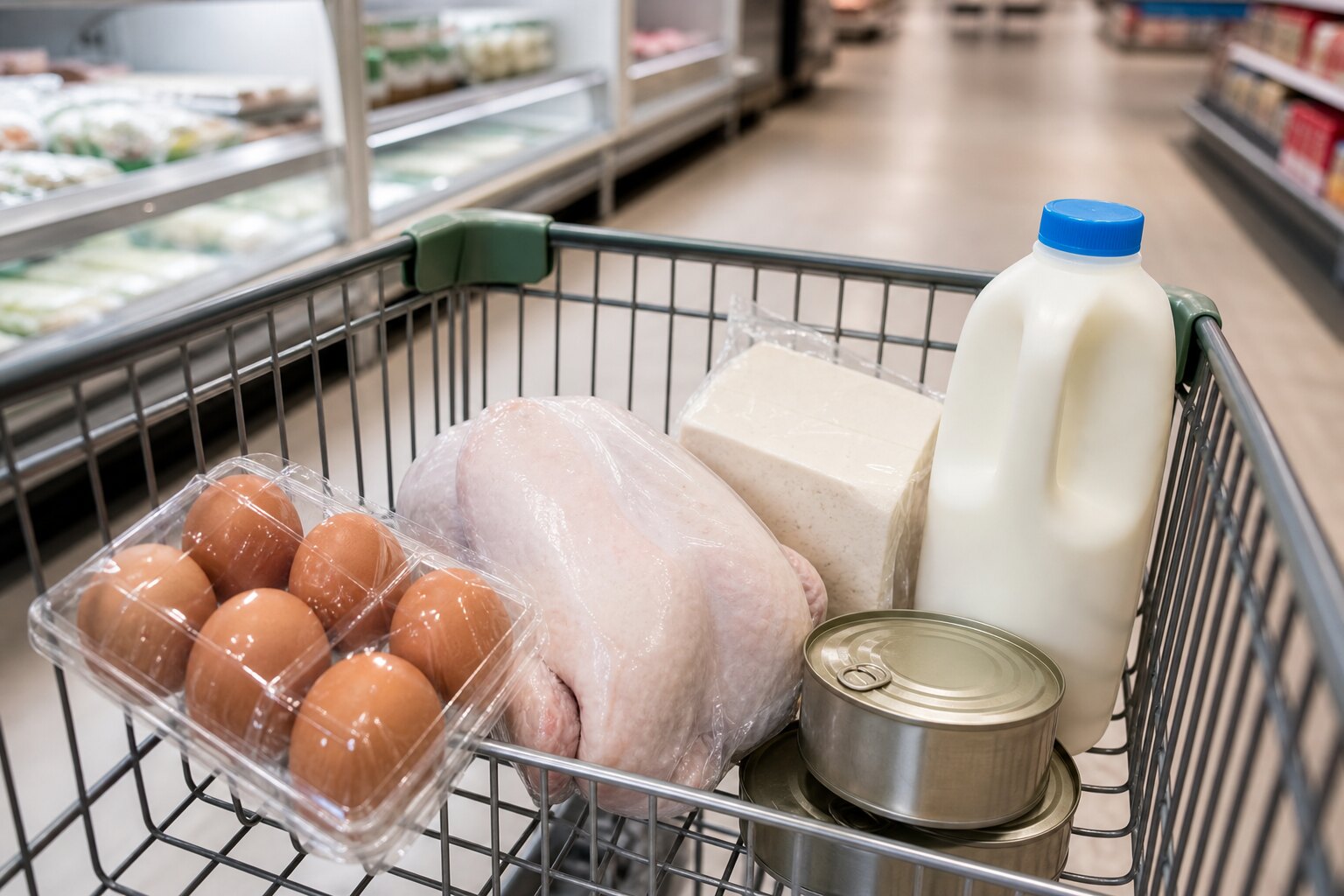
Most people asking me about cheap protein are really asking a trolley question. They have a fixed budget for the week’s groceries, a family to feed, and they want to know which items are actually pulling their weight.
So I ran the numbers properly. Two axes matter, and they are not the same axis. One is what a gram of protein costs you in dollars. The other is what it costs you in calories. An item that wins on both earns a permanent place in your trolley.
Where these prices come from, and what they are worth
Before any figures, the honest bit. National average prices come from SingStat’s average retail price series, table M213761, whose latest published period is June 2026. That is the newest official reading available, so please do not read these as today’s shelf price. Product-level prices are from FairPrice product pages at the time of writing, and supermarket promotions expire, so the exact dollar will drift.
Every cost per 20 g of protein below is our own calculation, worked from those prices and the protein figures on the products’ own labels. It is not a published statistic from any agency or retailer. Prices move. The ranking is the durable part. That is what I want you to take away.
The cost of 20 g of protein
| Item | Price used | Our cost per 20 g protein |
|---|---|---|
| Tau kwa, 400 g | $1.05 (FairPrice house brand) | $0.43 |
| Tau kwa, 450 g (2 pieces) | $1.42 (Unicurd) | $0.52 |
| Eggs, 30 per pack | $6.65 (Pasar) | $0.71 |
| Tempeh, 200 g | $1.75 | $0.86 |
| Eggs, per 10 | $3.29 (SingStat, Jun 2026) | $1.05 |
| Ikan bilis, 100 g | $3.66 | $1.13 to $1.46 |
| Canned sardines, 425 g | $3.87 (from SingStat per 100 g) | $1.38 |
| Chicken breast, 200 g | $3.18 | $1.41 |
| Chicken thigh, 350 g | $5.40 | $1.87 |
| Fresh milk, 1 litre | $3.51 | $2.30 |
| Canned tuna in water, 150 g | $3.48 | $2.80 |
The headline, and it surprised me: tau kwa comes out roughly six times cheaper per gram of protein than canned tuna. Eggs are second. A single 400 g block of house-brand tau kwa at $1.05 does what most of a $3.48 tin does, for a third of the money.
Some notes on the rows, because you deserve them. The ikan bilis figure is a range because HPB’s database carries two protein figures for dried anchovy that disagree by roughly 30%, so I have shown both ends rather than pick one. The tempeh calculation uses a USDA protein value, because no Singapore-sourced tempeh protein figure exists. The 12.2 g per 100 g I used for one tau kwa row is that specific brand’s own label, not a generic tau kwa number. And the canned tuna price was carrying a multi-buy promotion when I checked, which will not last.
The second axis: protein per calorie
Cheap is only half of value. If an item costs you 400 calories to deliver 20 g of protein, it is expensive in the currency that matters for fat loss. Here is the same shelf ranked by grams of protein per 100 calories, computed by us from the Health Promotion Board’s Singapore Food Insights Database, its Energy and Nutrient Composition data.
| Item | Portion | Calories | Protein | g protein per 100 kcal |
|---|---|---|---|---|
| Canned tuna, in water, drained | 150 g can | 174 kcal | 38.3 g | 22.0 |
| Canned tuna, in brine, drained | 150 g can | 153 kcal | 30.9 g | 20.2 |
| Baked chicken breast, no skin | 90 g piece | 103 kcal | 19.6 g | 19.0 |
| Canned sardine, in oil | 150 g can | 237 kcal | 36.3 g | 15.3 |
| Fried tau kwa | 111 g piece | 163 kcal | 18.6 g | 11.4 |
| Edamame | 150 g bowl | 91 kcal | 8.9 g | 9.8 |
| Skimmed milk | 250 ml glass | 93 kcal | 9.0 g | 9.7 |
| Whole egg, raw | 55 g | 68 kcal | 6.0 g | 8.8 |
Notice what happened. Canned tuna, the worst value in dollars, is the best value in calories. Tau kwa, the best value in dollars, sits mid-table in calories. Neither one is the answer. Both belong in the trolley, doing different jobs, and knowing which job each does is the actual skill.
One caveat on this table. Several of these entries are marked Borrowed in HPB’s database rather than analysed in a Singapore lab, and the food composition data spans 2010 to 2025. They are good enough to rank items against each other. They are not precise enough to audit your day.
How much you are actually aiming at
Singapore’s official Recommended Dietary Allowances document contains no protein figure. The operative number is in the National Nutrition Survey: 0.8 g per kg of body weight per day under 50, and 1.2 g per kg per day at 50 and above. MOH reported alongside the 2022 survey that while more than three in four residents met their recommended intake, “one in two older adults did not meet the recommended protein intake”.
HPB’s serving equivalents turn that into shopping. One serving is a palm-sized piece of meat, fish or poultry (90 g), or 3 eggs (150 g), or 2 small blocks of soft beancurd (170 g), or 5 medium prawns (90 g), or 3/4 cup of cooked pulses (120 g), or 2 cups of reduced-fat milk (500 ml). Seniors aged 50 and above are advised to aim for three servings a day.
And spread it out. HPB is explicit that “insufficient protein intake per meal affects the optimum muscle protein synthesis, even if the total protein required for the day has been met”. Leidy and colleagues, reviewing the research in the American Journal of Clinical Nutrition, found the benefits clustering around 25 to 30 g per meal. Two eggs at breakfast and a block of tau kwa at lunch changes a day more than a large dinner does.
Why I keep coming back to tau kwa and eggs
Beyond price, there is a second reason these two are my default recommendation. In MUIS’s own ingredient risk tiering for halal certification, eggs sit in the lowest band alongside plain seafood, legumes and vegetables, and soy bean products sit in the next band up. Dairy, processed seafood and canned foods sit higher, requiring a halal certificate or a lab report, and all meat and poultry sits highest, requiring a MUIS-recognised certificate. If you are shopping halal, eggs and tau kwa are the two lowest-friction items on the whole list, and both of the tau kwa products I priced carried halal marking on the pack. You can verify any product yourself on MUIS’s halal register, and since 1 October 2025 MUIS certificates are digital and carry a QR code.
What actually goes in the trolley
If I were writing your list, it would be short. A 30-pack of eggs. Two blocks of tau kwa. One tin of tuna in water for the days you need protein with almost no calories attached. Chicken breast when the budget allows, thigh when it does not, and milk if you drink it anyway.
Watch salt on the canned items and check the panel on your own tin, because sodium varies enormously between products and HPB’s recommended daily limit is 2,000 mg. If you have kidney disease, high blood pressure, diabetes, an eating disorder, or you are pregnant, talk to your doctor before changing how much protein you eat. Some conditions call for less, not more, and that is a medical decision.
Prices will have moved by the time you read this. The order will not have moved much, and that is the part worth remembering.
Sources
- Department of Statistics Singapore, 2026. Average retail prices of selected consumer items, table M213761, latest period June 2026. https://tablebuilder.singstat.gov.sg/table/TS/M213761
- Health Promotion Board, 2026. Singapore Food Insights Database, Energy and Nutrient Composition of Food. https://pphtpc.hpb.gov.sg/web/sgfoodid/tools/food-search
- Health Promotion Board, 2026. Why protein is important. HealthHub. https://www.healthhub.sg/well-being-and-lifestyle/food-diet-and-nutrition/why_protein_is_important
- Ministry of Health Singapore, 2023. National health surveys highlight need to focus on healthy diets and lifestyles. https://www.moh.gov.sg/newsroom/national-health-surveys-highlight-need-to-focus-on-healthy-diets-and-lifestyles/
- Leidy HJ et al., 2015. The role of protein in weight loss and maintenance. American Journal of Clinical Nutrition. https://doi.org/10.3945/ajcn.114.084038
- Majlis Ugama Islam Singapura (MUIS), 2026. Halal certified establishments and products directory. https://halal.muis.gov.sg/halal/products
- Majlis Ugama Islam Singapura (MUIS), 2026. Halal certification. https://www.muis.gov.sg/halal
Not sure where you actually stand?
Answer seven questions and get your own daily calorie and protein target, plus a realistic date for your goal weight. Free, and no payment details.