
Hawker Food Calories: What Is Actually on Your Favourite Plate
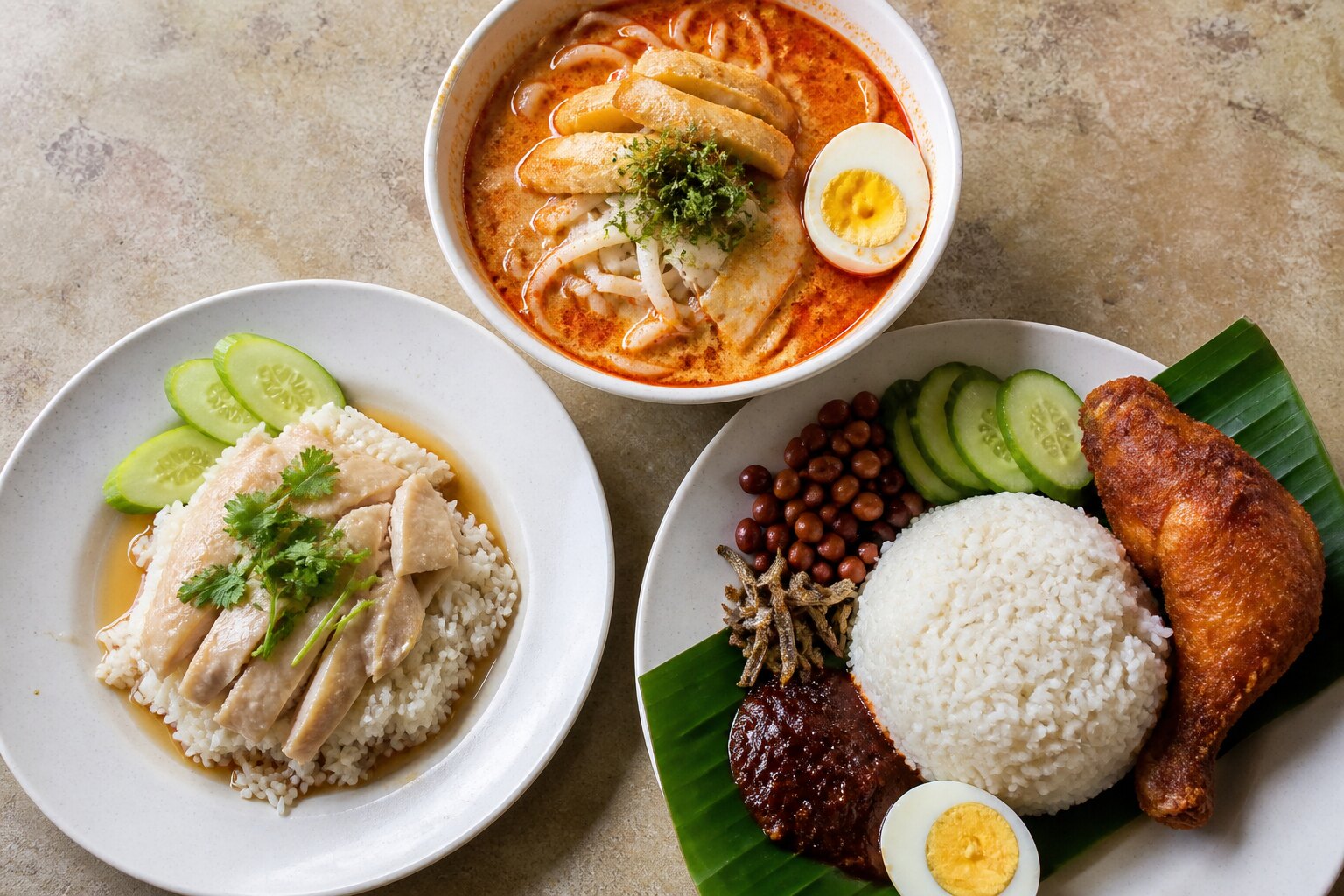
Almost every person who starts with me asks the same question in the first week. “Coach, how many calories in char kway teow?” It sounds like a question with one answer. It is not. And the reason why is more useful to you than any single number I could give.
Here is the short version. Singapore’s Health Promotion Board publishes two different numbers for char kway teow, and both are on HPB’s own material right now.
Two numbers, one government agency
HPB’s Energy and Nutrient Composition database, the SG FoodID dataset, lists char kway teow at 989 kcal for one plate of 480 g. That entry is marked Lab Analysis and dated 2025. It also gives you the rest of the plate: 25.73 g protein, 42.72 g fat, 14.16 g saturated fat, 125.04 g carbohydrate and 2,107 mg sodium.
HPB’s consumer-facing site, HealthHub, says char kway teow is 744 kcal, on a 384 g serving.
That is a gap of 245 calories between two publications from the same agency. And it is not just calories. The database says the 480 g plate carries 14.16 g of saturated fat. The figure circulating via HealthXchange.sg, SingHealth’s consumer health portal, is 29.2 g of saturated fat on the smaller 384 g serving. More than double the saturated fat on less than the food.
I am not going to tell you which one is right. I genuinely do not know, and nobody has published the work that would settle it. What I can tell you is where each number comes from, because that part is traceable.
Where the famous 744 actually came from
The 744 kcal figure travels in a set. Char kway teow 744, nasi lemak 657, chicken rice 607. You have seen that set. It is on posters, in office Slack channels, in every “worst hawker dishes” listicle since about 2015.
Follow it back and the trail stops at a food blog. The earliest appearance we could find is LadyIronChef, 27 July 2014, attributing the figures to a private dietitian, with no stated method, no sample size and no reference. Six years later AsiaOne republished the same set on 1 October 2020, this time credited to HPB, and added a basis: a 23 cm plate and a 16.5 cm bowl. HPB does not state that basis anywhere we could find. A third version circulates through HealthXchange.sg, published with SingHealth’s KKH Nutrition and Dietetics team, carrying no author, no date and no data source.
So one number has a documented portion weight, a collection year and a Lab Analysis flag. The other has twelve years of republication. I will say plainly that HPB’s database is the better-documented of the two, because it tells you what it weighed and when. That is not the same as calling the other one wrong.
The conflict, side by side
All left-column figures are from HPB’s SG FoodID database. Right-column figures are the widely circulated media and hospital set.
| Dish | HPB SG FoodID | HPB kcal per 100 g | Circulated figure |
|---|---|---|---|
| Char kway teow | 989 kcal / 480 g | 206 | 744 kcal / 384 g |
| Roasted chicken rice | 643 kcal / 363 g | 178 | 607 kcal / 382 g |
| Laksa | 429 kcal / 604 g | 71 | 591 kcal / 540 g |
| Nasi lemak (chicken wing set) | 831 kcal / 410 g | 218 | 657 kcal / 306 g; KKH 494 kcal / 210 g |
| Mee goreng | 856 kcal / 465 g | 184 | 500 kcal / 309 g |
| Plain prata | 496 kcal / 141 g | 352 | 209 kcal / 70 g (KKH) |
| Fried carrot cake (black) | 606 kcal / 331 g | n/a in our pull | 493 kcal / 295 g |
| Economy rice | 19 entries, 609 to 1,238 kcal | varies by combination | 580 kcal, one number |
Look at the right-hand column and the left-hand column together and something jumps out. In almost every row, the lower calorie figure comes attached to a smaller portion weight. Laksa is the exception, and it is instructive: HPB’s bowl is 604 g and 429 kcal, the circulated bowl is 540 g and 591 kcal.
The lesson that actually matters
A calorie number without a portion weight attached is close to meaningless. That is the whole finding. Not “the media got it wrong”, not “trust HPB blindly”. Just: ask what was weighed.
Look at how much the basis drives everything. Per 100 g, laksa is 71 kcal, char kway teow is 206 kcal and plain prata is 352 kcal. By that measure prata is the most calorie-dense of the three by a wide margin. But a prata is 141 g and a bowl of laksa is 604 g, so per plate, laksa lands at 429 kcal and one prata at 496 kcal. Same data, opposite conclusion, depending entirely on whether you are looking per gram or per plate.
Two more examples from the same database make the point better than I can.
Economy rice has no single number at all. HPB lists 19 economy-rice combinations spanning 609 to 1,238 kcal. “1 vegetable, 1 fish” is 609 kcal on a 497 g plate. “1 vegetable, 2 fried meats” is 1,165 kcal on 640 g. Anyone who quotes you “cai png is 580 calories” is quoting a number that does not exist as a single thing.
Yong tau foo swings by hundreds of calories under one dish name. Seven pieces in clear soup, mixed, at 771 g comes to 594 kcal. The same seven pieces fried, at 928 g, comes to 1,206 kcal. Frying roughly doubles it and adds about 43 g of fat. Nobody at the stall calls those two different dishes. You order “yong tau foo” both times.
A word on that database, while we are here. HPB itself says the figures are averages of multiple samples rather than any one stall, and that it makes no guarantee the data is error free. That is a fair warning and worth taking seriously. There is an entry for boiled yong tau foo that reads 82 kcal for a 745 g bowl, which works out to about 11 kcal per 100 g. Seven pieces of tofu and fish paste cannot be 11 kcal per 100 g. I am not going to quote it as a fact, and I mention it only because it is a useful reminder that even the best source we have is not flawless.
Even the researchers disagree
This is not just a consumer-publishing problem. Peer-reviewed work disagrees with HPB too. Yeo, Bi, Yeo and Henry lab-analysed 45 local meals in Foods, 2021, and reported laksa at 153 kcal per 100 g against HPB’s 71, and roti prata at 208 against HPB’s 352. But read their methods and you find the meals were “purchased from a local food court (Kopitiam, Singapore)”, a single operator, with no measurement of variation between outlets.
A*STAR’s Professor Henry put it about as honestly as it can be put: “the calorie and macronutrient profiles of many local foods have yet to be extensively determined.”
So what do I actually tell my clients
Three things, and none of them involve memorising a number.
Stop chasing precision you cannot have. If the official sources disagree by 245 calories on one plate, your app entry to the calorie is theatre. Track consistently, not precisely. The same slightly-wrong number every day still shows you the trend, and the trend is the thing you act on.
Learn the levers instead. Boiled instead of fried moved yong tau foo by more than a thousand calories. Fish instead of two fried meats moved cai png by over 500. Those levers are enormous and they do not need a database to use. Wet over dry, less oil, more protein on the plate.
Judge by the plate in front of you, not the number on the poster. Your uncle’s plate of char kway teow is not HPB’s 480 g plate and it is not the blog’s 384 g plate. It is whatever he served you. Portion is the one variable you can see with your own eyes, and it is the one that moves the number most.
None of this is medical advice, and none of it treats or prevents anything. If you are managing diabetes, blood pressure, cholesterol or any other condition, or you are on medication, please talk to your doctor or a registered dietitian before you change how you eat.
I have been coaching Singaporeans around hawker food long enough to know that nobody quits it and nobody should have to. You just need to stop treating a poster number as a fact about your dinner, and start treating your own plate as the thing you are actually managing.
Sources
- Health Promotion Board, accessed 2026. Energy and Nutrient Composition of Food, SG FoodID database. https://www.hpb.gov.sg/
- Health Promotion Board / HealthHub, 2025. Local dish calorie listings on the consumer site. https://www.healthhub.sg/
- LadyIronChef, 27 July 2014. Calorie counts of local hawker dishes, attributed to a private dietitian. https://www.ladyironchef.com/
- AsiaOne, 1 October 2020. Republication of the hawker calorie set, credited to HPB. https://www.asiaone.com/
- HealthXchange.sg, SingHealth with KKH Nutrition and Dietetics, undated. Hawker food calorie and saturated fat listings. https://www.healthxchange.sg/
- Yeo, Bi, Yeo and Henry, 2021. Energy density and macronutrient composition of 45 Singaporean meals. Foods 10(7):1659. https://doi.org/10.3390/foods10071659
Not sure where you actually stand?
Answer seven questions and get your own daily calorie and protein target, plus a realistic date for your goal weight. Free, and no payment details.